




.svg)
Sooner or later, every fitness CMO gets the same brief: the site needs an overhaul, the budget is tight, and leadership wants proof before anyone signs off.
A template feels like the safe bet. It's quick to launch and easy to price, and for a single boutique studio it's often the right call. A 30-location chain is another matter. Once member data, class schedules, and integrations span dozens of clubs, cheaper stops meaning better.
It's a bigger decision than picking a theme, but it doesn't have to be a daunting one. You don't need to be technical to make the call, and your team already knows where the current site falls short.
What you do need is a clear view of how each option affects the numbers you're measured on, such as lead-to-member conversion, booking completion, and how long members stay. Settle that before you commit budget to any website development project.
What you get with a template website
A template website runs on a prebuilt design. You pick a ready-made layout, drop in your own copy, photos, and brand colors, and publish. The upfront cost is low, you don’t need a developer on payroll, and launch takes weeks rather than months.
For a single studio, that’s often plenty. The trouble starts at scale. Picture a chain with 50 clubs, each running its own timetable, local offers, and opening hours.
A template’s structure is set in advance, so growth shows up as workarounds. Location pages get copied and edited by hand, and promotions get squeezed into layouts never meant for them. Multiply that by 50 clubs, and keeping the site current turns into a full-time job.
What a custom website actually means
A custom website is designed and built for your brand from the ground up, with no template underneath. Sometimes that’s a brand-new site. Other times it’s a rebuild of what you already have, keeping what works and redesigning what doesn’t.
With a template, you start from ready-made designs and fill them with content. With a custom build, the structure starts from how your members actually search, compare, and sign up. The design is yours too, so your site doesn’t look like every other gym running the same theme.
Smoother UX where members pay
Payments are one of the moments where UX matters most. According to Athletech News, 40% of former gym members had their membership canceled because of a payment failure, not a decision to leave.
A lot of that is fixable with better design. Updating payment details should take a few taps, not a call to the front desk, and failed-payment messages should say clearly what to do next.
Template vs custom website: how they compare for fitness chains
The real comparison between a template and a custom build comes down to four things: scalability, integration, conversion, and long-term cost.
Scalability
Growth tests a website in ways that aren't obvious at first. A January campaign can send traffic spiking across every club at once, and a site that slows down at that moment loses sign-ups it won't get back. A custom build can be sized for those peaks from day one.
It also makes room for what a chain adds as it grows. That might be pre-sale pages that start signing up members before a new club opens, or local managers updating their own club page while the brand stays consistent everywhere.
Integration
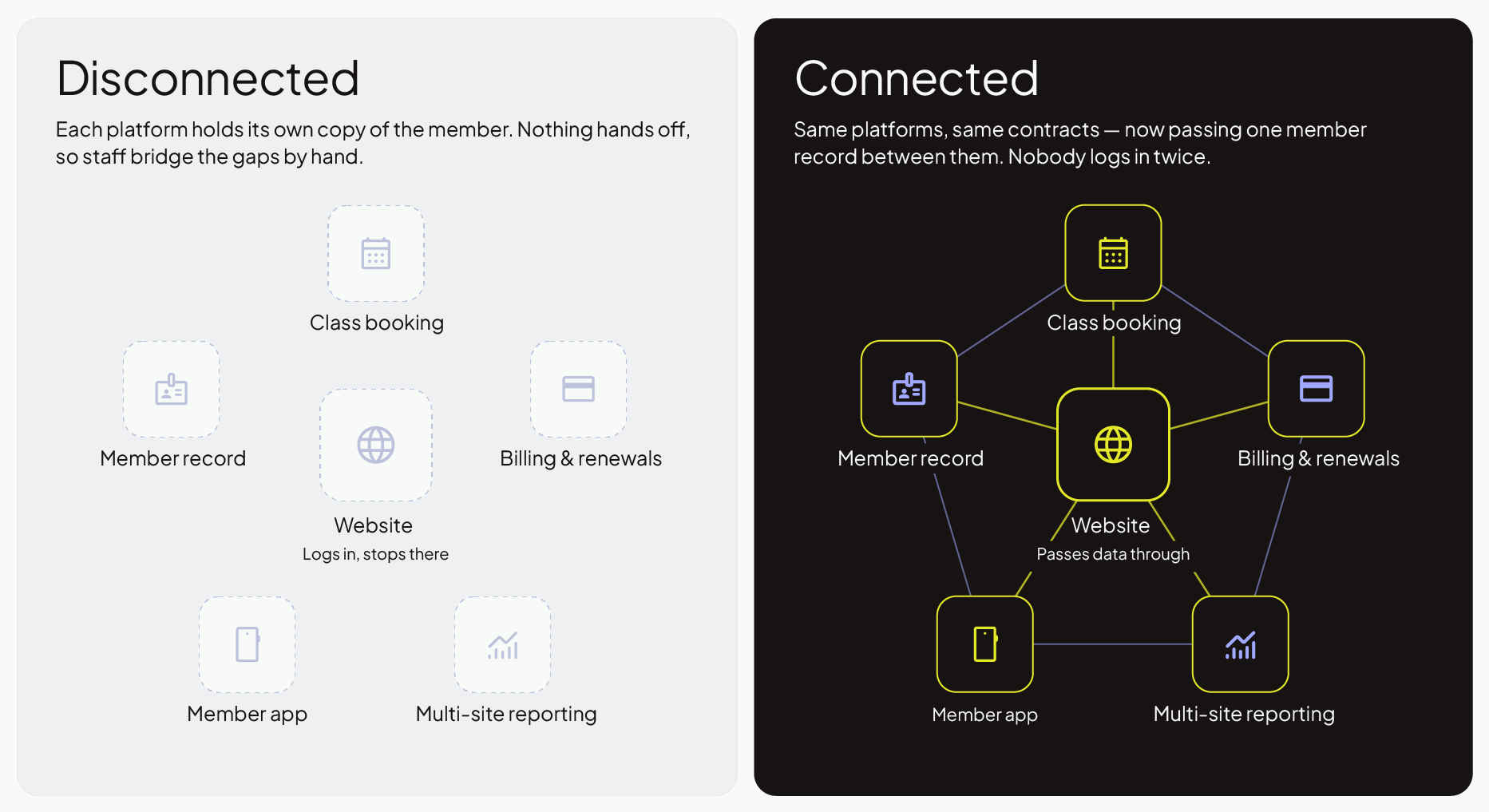
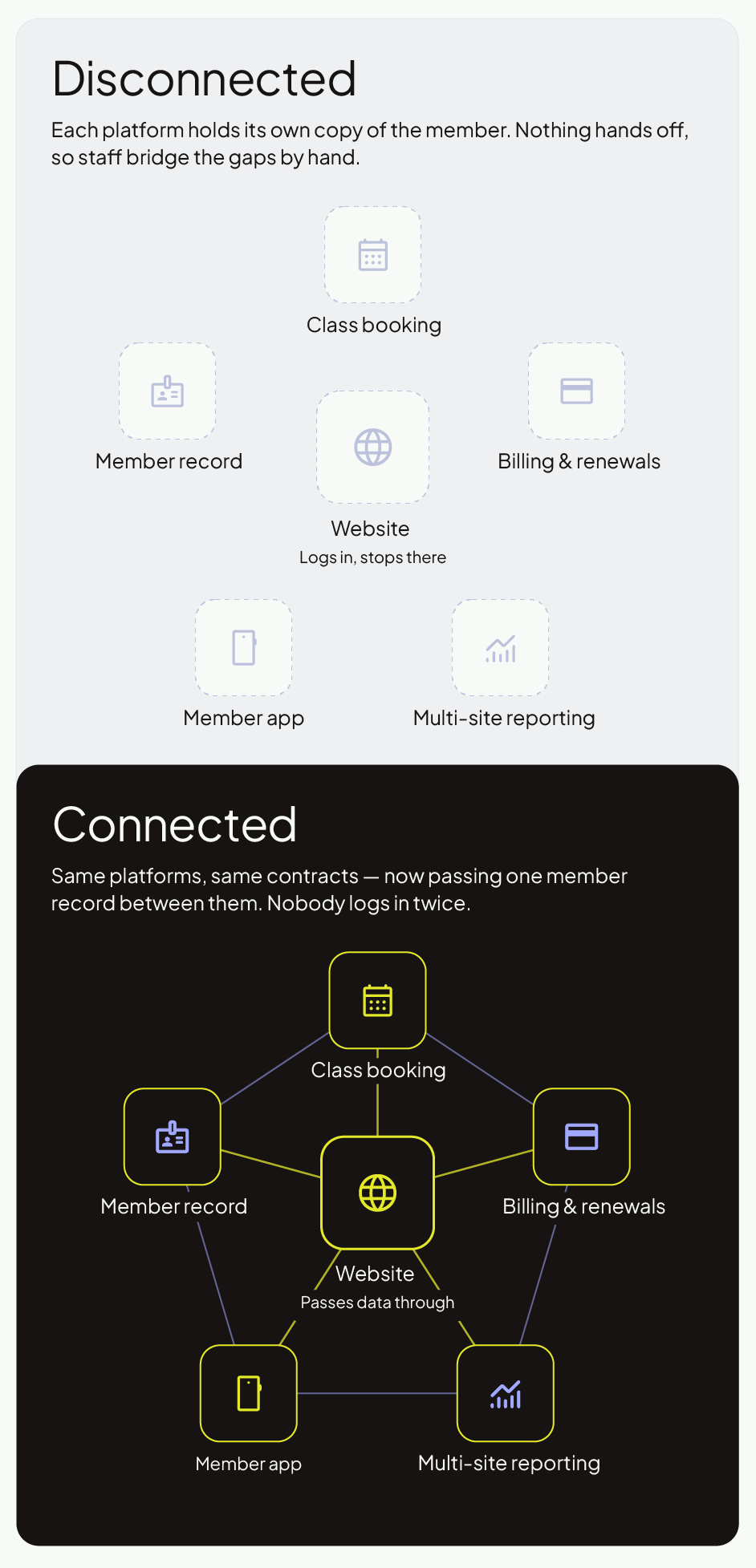
Both options can connect to the club management platforms chains already use, such as ABC Fitness, Glofox, or Mindbody. What differs is how much control you have over the experience around that connection.
On a template, booking and membership tools usually sit inside embedded widgets, styled within the theme’s limits. On a custom build, those flows are designed as part of the site, so they match your brand and member journey.
Conversion and lifetime value
Conversion is the piece leadership cares about most, so talk about it the way you already report it: conversion rate (CVR) on trial and join pages, customer acquisition cost (CAC), and ROI.
The website also keeps working after someone signs up. An EGYM survey of fitness operators found that only a quarter of gyms let members manage their entire membership online. Every task that sends a member back to the front desk adds friction to the customer journey, and over time that wears down lifetime value (LTV).
Total cost of ownership
Then there’s total cost of ownership, which rarely shows up until year two. On a template, it usually breaks down like this:
- Platform subscription and hosting fees
- Paid plugins, apps, and license renewals that grow along with the site
- Hours your marketing team spends on manual updates and workarounds
Switching later often means rebuilding from scratch anyway, so you pay twice. A custom build front-loads more of the cost, but you end up with a system you own rather than one you rent piece by piece.
Signs your club has outgrown its template
Personalization is usually the first tell. McKinsey found that 71% of consumers expect personalized interactions, and 76% get frustrated when brands fall short. A prospect browsing your Austin club shouldn’t see the same homepage as someone checking class times in Dallas.
The second is tracking. If your site can’t show where a lead came from, you’re making acquisition calls on guesswork. When both signs show up together, it’s usually time to look at custom website development instead of another template patch.
How to make the case to leadership without overpromising
Tie the pitch to numbers leadership already tracks, like acquisition cost, member lifetime value, and retention. Lead volume on its own is easy to inflate and just as easy to dismiss.
Don’t promise a revenue figure you can’t defend in the follow-up meeting. Frame it as risk reduction, then adjust the angle for each person at the table:
- CEO: a distinctive brand experience that supports expansion into new markets without a rebuild.
- COO: fewer manual location pages and workarounds, plus a site that scales every time a new club opens.
- CTO: clean integration with your club management platform and a codebase you fully control with your technology partner.
- CFO: a predictable total cost of ownership and results from phase one before the next budget is approved.

The right call depends on where your chain is headed
A single studio with a steady member base rarely needs more than a template. A chain adding locations is playing a different game.
The gap shows up in retention. Fitness On Demand, a digital fitness provider, reports that its digital offerings have been linked to a 17% increase in member retention. It's one vendor's figure, so read it as a direction rather than a benchmark. The direction still holds: members who stay connected between visits tend to stay longer, and your website is where that connection begins, from booking to billing to account updates.
For a CMO, that shifts the template question from launch speed to customer lifetime value. A site that grows with your chain protects the members you've already won, not only the leads you generate.
Custom isn’t the automatic answer for every chain, but the decision deserves an honest look at where you stand today. Qodeca’s team of experts can help you figure out which side of that line your chain is on.
FAQ
How much does a custom website cost for a multi-location fitness chain?

Cost depends mainly on scope, integrations, and the complexity of the backend behind the marketing website.
A site connecting booking and payments will cost less than one with a member portal, multi-location content management, centralized reporting, and more complex system integrations. You pay for what your business actually needs.
How long does a custom website build typically take?
A custom build for a fitness chain typically runs two to four months from discovery to launch.
A template can go live in less time, but that speed trades off against a system that actually holds up once bookings, billing, and member data are all running through it at once.
Can I switch from a template to a custom site without losing my existing content or search rankings?
Yes, switching to a custom site doesn't have to cost you existing content or rankings, as long as the migration is planned properly.
The real risk is broken URLs and missing redirects, not the switch itself. Done right, a proper migration maps every old page to its new equivalent and can even improve rankings over time.
Do I need to hire an in-house developer to maintain a custom website?
No, most fitness chains don't need an in-house developer, since ongoing support is usually handled by the technology partner instead.
That's one of the stronger arguments for custom web design services over a template: you get full ownership of the system and a CMS your marketing team finds easy to use, without building a tech team around it.
Do I have to switch everything at once, or can I upgrade in phases?
No, most chains phase it in rather than replacing everything at once.
Start with whatever's causing the most friction today, usually booking or billing, prove it out, then expand from there. That approach also makes the CAC and LTV case easier, since leadership sees results from the first phase before approving the next.