.avif)


.svg)
For many fitness COOs, rising operating costs seem inevitable. Salaries increase, energy prices fluctuate, and rent negotiations get tougher every year. These factors are real, but they are rarely the main reason margins erode across multi-location fitness businesses. This is especially true in fitness operations management for gym chains, franchises, and boutique studios.
In fact, the biggest pressure on operational costs in gyms comes from something far less visible: poor data quality, fragmented systems, and manual work created by disconnected tools. In modern fitness operations, costs grow not because teams are too large, but because data does not flow.
If you’re a fitness COO responsible for fitness operations management across multiple clubs, ask yourself: is it really rising expenses that hurt your margins, or is it the hidden cost of disconnected data?
What’s secretly destroying your margins in fitness operations?
Most fitness chains already rely on SaaS tools: CRM platforms, billing systems, member apps, booking engines, access gates, and equipment trackers. These tools are valuable, but without system integrations, they create data silos.
The hidden costs of disconnected workflows
This is where hidden costs begin to surface: in manual handovers between systems, duplicated data entry, and repeated operational tasks that consume time without adding value. For example, front-desk staff exporting attendance data from one system and re-uploading it into another, finance teams reconciling membership payments across disconnected platforms, or managers manually compiling monthly performance reports in spreadsheets.
What are the factors affecting profit margin?
The hidden costs also stem from a lack of digital integration and limited visibility into real costs per club, product, or member segment. Without unified data, profitability becomes difficult to assess.
You may not know whether small group training is truly profitable. You may not see which clubs operate with structurally higher staffing costs. You may not fully understand how much churn is costing each location. When this visibility is missing, inefficiencies remain hidden. And protecting margins becomes reactive instead of strategic. Each issue alone seems manageable. Together, they create ongoing reducing operational inefficiencies challenges and inflate operating costs month after month.
Why data quality and flow decide cost stability
In scalable fitness operations, stable costs depend on clean data and predictable information flow. This is the foundation of controlling operational costs.
Manual errors that increase operational costs
Consider a common scenario. Your front desk manually processes 300 billing corrections per month. That equals around 20 hours of work — every month — regardless of revenue or traffic. This is a fixed cost embedded in your operation.
Now apply SaaS integration in fitness by connecting CRM and billing systems through proper integration solutions. Corrections drop to 10 per month. Manual effort largely disappears. The cost becomes variable, low, and directly tied to real usage.
This is how automating fitness workflows transforms fixed expenses into controlled variables and supports long-term cost reduction.
Preventing revenue leakage through system integration
But cost stability is not only about reducing manual work. Poor data flow also creates revenue leakage. Missed payments, duplicated discounts, expired memberships that still allow access, or failed renewals that go unnoticed, these small gaps quietly reduce top-line revenue.
Sealing these system gaps usually requires a relatively small financial investment compared to infrastructure overhauls. Yet even minor integration improvements can immediately reduce leakage and improve cash flow. In many cases, simply synchronizing billing, access control, and CRM systems is enough to recover lost revenue.
When data moves reliably between systems, both costs and revenue become predictable. And predictability is what ultimately protects margins.

Off-the-shelf systems are not the problem. Isolation is
CRM platforms, billing tools, and member apps are not the issue. The problem is the lack of integration architecture between them.
Without system integration in gyms, each tool becomes an isolated source of truth. Data is copied manually, reports conflict, and leadership makes decisions without full visibility. Over time, this blocks business optimization and limits business efficiency.
Once systems are connected through a clear enterprise architecture, data becomes shared, consistent, and actionable. Research shows that this is when data-driven decisions stop being theory and start shaping daily operations [2].
Your IT architecture might be blocking growth
Many leaders still treat auditing IT architecture as a technical task. In reality, an IT architecture audit for fitness chains is a core operational instrument that directly impacts margins.
Without an audit
20 clubs, multiple systems, no shared analytics. The COO cannot see which clubs are profitable, where costs escalate, or why performance varies.
More importantly, the COO often does not know where money is actually leaking. Poor performance becomes a guessing game. Is it weak marketing? Low trainer productivity? Pricing? Churn? When data is fragmented, leadership operates on assumptions instead of evidence.
This affects the entire C-level. The CFO sees rising costs but cannot trace their operational source. The CMO may increase marketing spend to fix declining memberships, believing demand is the issue. Meanwhile, the real problem might be a broken onboarding process in the member app. Data chaos masks root causes. As a result, well-intentioned decisions amplify inefficiencies instead of solving them.
After an audit
You gain a clear data flow map and defined integration architecture. CRM connects with billing and access control. Reporting becomes automated and consistent across locations.
Suddenly, data-driven decisions for COOs become possible. And this is based on facts rather than conflicting reports. Performance gaps can be traced to specific operational bottlenecks. Cost drivers become visible. Margin erosion can be addressed at its source.
An IT architecture audit for fitness chains does not generate cost. It exposes existing inefficiencies and enables smarter cost management strategies for fitness clubs.
Can AI cut costs in fitness operations? Yes, if you use it right!
When data flows correctly, AI in fitness operations becomes a practical tool for daily cost control.
Here’s how AI in fitness supports cost reduction and scalability:
- It analyzes club occupancy and recommends optimized staffing and class schedules based on real demand.
- It improves workflow efficiency across multi-club operations.
- It predicts churn and enhances customer service processes, reducing acquisition and service costs while strengthening retention.
- It monitors equipment and enables predictive maintenance, preventing downtime and unexpected repair expenses.
- It automatically detects operational inefficiencies, such as spikes in manual billing corrections.
- It supports intelligent task routing through AI-driven orchestration, making it possible to automate fitness workflows at scale.
- In addition, customer behavioral profiling enables more targeted offers and smarter data analytics for gyms, helping operators allocate resources more effectively.
AI does not replace teams. It supports them by improving business efficiency and accelerating data-driven decisions.
A simple example of integrated data flow
Here’s how digital integration looks in a real multi-club environment:
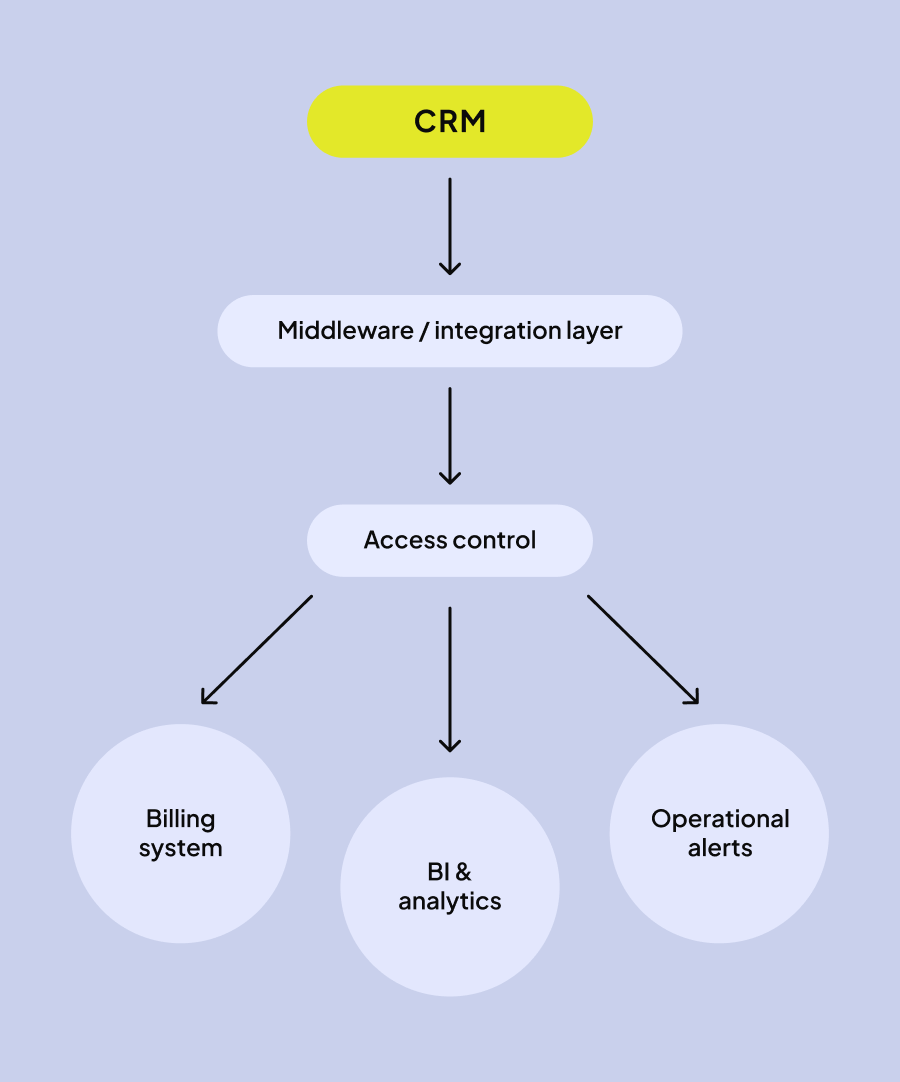
With this setup, membership data updates automatically across all systems, billing reflects actual usage without manual corrections, and access issues trigger real-time alerts. At the same time, consolidated reports give you clear visibility per club, supporting accurate cost control and better operational decisions.
This is how integration solutions unlock visibility and support improving business efficiency in fitness.
Want stable margins? Start with operational predictability
When operating costs are driven by manual work and fragmented data, predictability disappears. Decisions become reactive, and fitness operations management turns into constant firefighting.
By investing in enterprise architecture, system integrations, and AI in fitness operations, you restore predictability. And predictability creates stability.
This is not about cutting people or reducing service quality. It’s about smarter workflow optimization, better business optimization, and technology that supports growth.
With the right technology partner, you gain full control over your fitness operations. You eliminate data silos, connect your systems through effective SaaS integration for fitness clubs, and build an ecosystem that truly supports your business growth and operational efficiency.
Because when technology works in your favor, operating costs stop being a risk – and become a competitive advantage.
Sources:
- García-Fernández, J. et al. (2022) The Digital Transformation of the Fitness Sector: A Global Perspective. Emerald Publishing Limited. Available at: https://doi.org/10.1108/9781801178600. (Accessed: 24 February 2026).
- Solano, M.C. (2024) Integrating analytics in enterprise systems: A systematic review of impact and innovations. Administrative Sciences, 14(7), 138. Available at: https://www.mdpi.com/2076-3387/14/7/138 (Accessed: 24 February 2026).