


Picture the quarterly leadership meeting. The strategy deck looks sharp: growth targets, retention goals, and a clear plan for the next twelve months. Everyone nods. Three months later, almost nothing has moved.
Most fitness leaders know where they want the business to go. The hard part is turning that plan into numbers your team can act on, with a clear owner for each one. Often the gap only shows up under pressure. You’re opening another club, or a board member wants to know what has really changed since last quarter.
And the market is expanding. US fitness memberships reached a record 81 million in 2025, representing 26.1% of the population aged 6 and older. But a rising market can hide a shrinking share. If your club grows more slowly than the industry, you can lose ground without realizing it.
A strategy nobody can track is hard to execute. Eventually, it becomes a wish with a deadline.
Why does strategy execution break down in growing fitness businesses?
Strategy execution usually breaks down when a fitness business cannot turn its data, KPIs, and technology into a consistent operating process. In growing fitness businesses, three issues tend to create the biggest gaps: data that does not connect, KPIs that are not actively managed, and technology that starts limiting strategic decisions.
Your data is telling different stories
The first cracks appear in the data. When membership, marketing, and finance sit in separate systems, leadership gets a different answer depending on which one they check.
How is retention performing across locations? Which campaigns are actually bringing in members? Where did performance change last month?
Usually, someone has to pull the pieces together by hand before the leadership team can make a decision.
That delay matters. A CEO comparing three reports to answer one question is already working with a partial picture.
Without one reliable source, decisions start to rest on interpretation rather than evidence.
Your KPIs exist, but the operating rhythm doesn't
KPIs stop driving execution the moment nobody owns them week to week, no matter how strong the strategic planning process behind them was.
Take retention. A quarterly report might tell you that it fell by two percentage points. It doesn’t necessarily tell you which locations are responsible, which member groups are leaving, or what changed before the decline appeared.
Two points can sound minor. For a chain with 10,000 members paying $50 a month, it means roughly $120,000 in lost annual revenue. The early warnings are usually there, too: members who cancel tend to visit less often in the weeks before they leave. Without joined-up data, nobody spots that pattern in time.
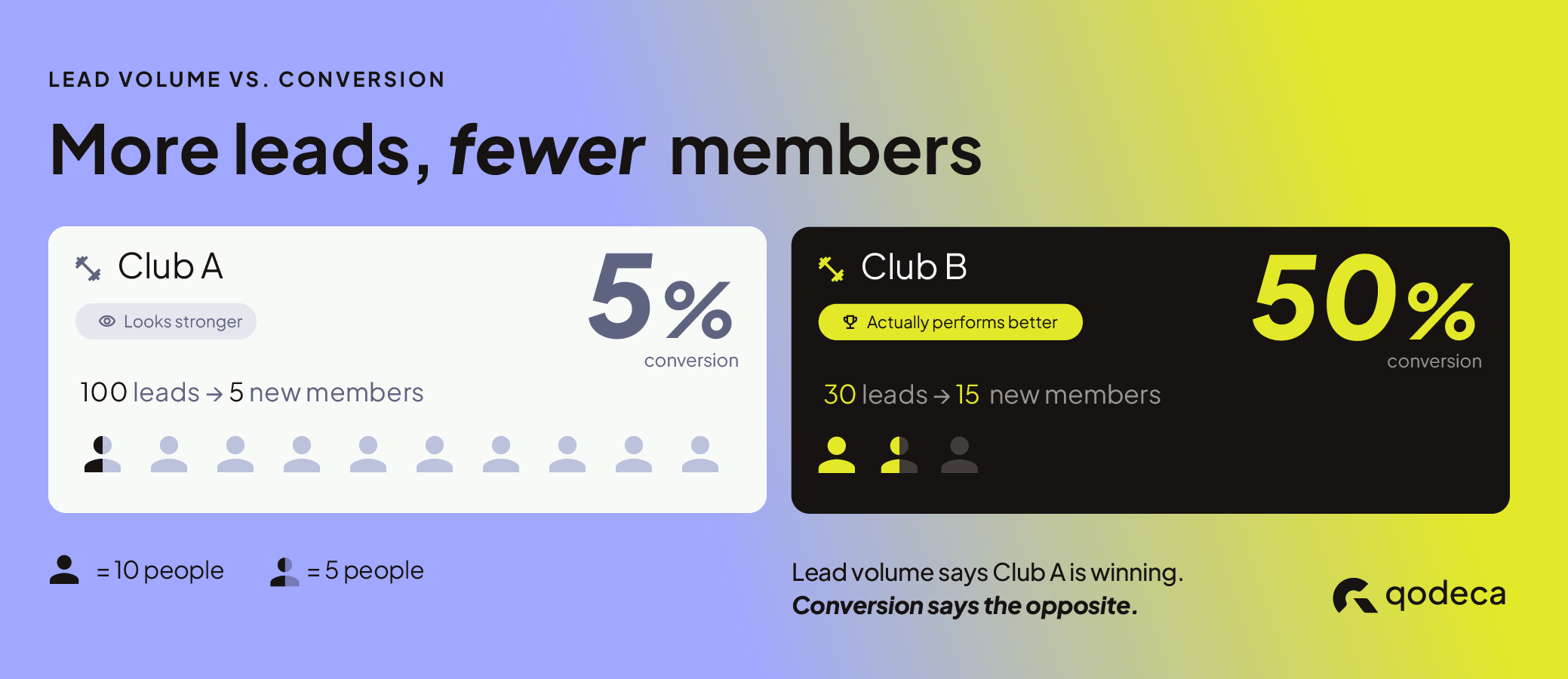
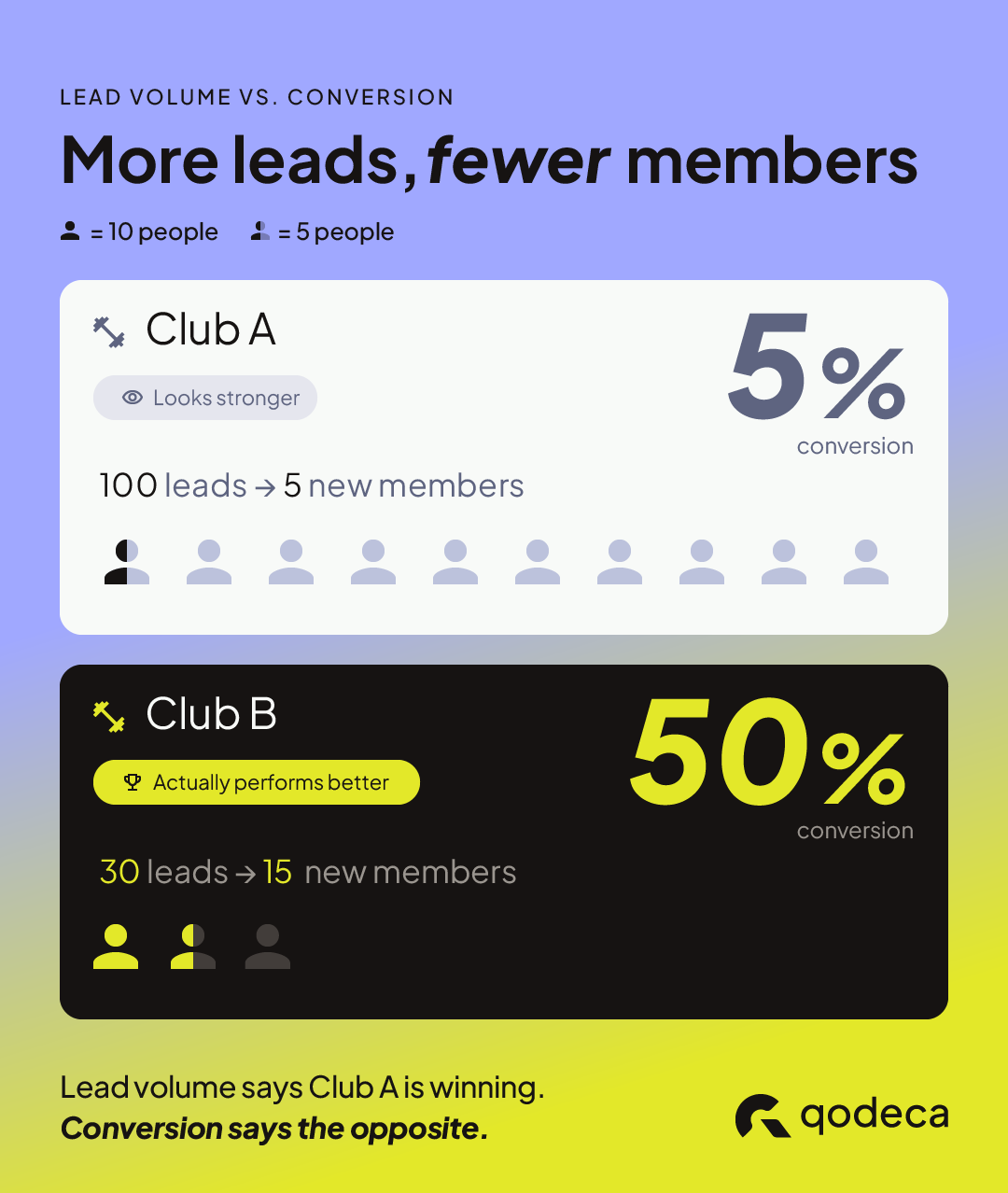
The same problem shows up in acquisition. Consider two clubs: one generates 100 leads and converts five members; another generates 30 leads and converts 15. Lead volume alone makes the first club look stronger. The conversion rates point the other way.
Measuring well starts with choosing which figures matter and why. If the goal is to grow membership, that ratio says far more than the raw lead count.
Effective KPI tracking gives leadership enough context to decide what happens next. That only works when someone owns each important metric, reviews it regularly, and knows when the result calls for action.
Your software starts dictating what the business can do
This tends to surface when a successful chain starts changing faster than its technology stack.
A platform handles the current membership model well. Then leadership wants to introduce a new pricing structure, run a promotion across several locations, or connect data that currently sits in separate systems. Suddenly, a strategic decision comes with a list of technical limitations.
The conversation quietly shifts from “What should the business do?” to “What can the platform support?”
That is when technology becomes a strategic constraint.
The answer may be an integration, a change in workflow, a new layer of software, or a larger technology decision.The important part is knowing which bottleneck you are dealing with before it starts shaping the plan.

What can a business strategy audit actually uncover?
A business audit doesn't have to mean a six-month review of every process and system. For a CEO, a useful first pass can be much more focused: compare what the strategy says should be happening with what the business can actually measure and manage today.
Start with the strategic priorities. For each one, ask:
- Can we measure the outcome today? If the number is estimated, manually assembled, or unavailable, flag it.
- Where does the data live? Map the systems behind each important metric.
- Who can access it? A KPI locked inside a specialist's spreadsheet is difficult to manage at leadership level.
- Who owns the result? Every major goal needs a person responsible for moving it forward.
- What could block the initiative? Look for system limitations, manual processes, missing integrations, or dependencies between teams.
This turns a business strategy plan into something you can test against the reality of the operation.
It also shows where the biggest gaps sit, whether that is poor measurement, unclear accountability, or technology that has not kept pace with the business.
Could your strategy survive a closer look?
Ask yourself five questions:
- Can you name last month's retention number without asking anyone?
- Would your systems and reporting scale if a new location opened tomorrow?
- Does at least one system share data with another without a manual export or import?
- Is someone other than you accountable for each strategic KPI?
- Could you defend the strategy's progress to an investor today, with numbers?
Two or more “no” answers are a useful signal. The execution gap is already there. More locations will only make it wider.
Where should a fitness CEO go from here?
The larger the chain becomes, the more expensive an invisible execution gap can be. More locations bring more data, systems, teams, and decisions that need to stay aligned.
That matters in markets where fitness businesses are still expanding quickly. European membership reached 75.5 million in 2025, while a recent UAE industry report found that six in ten operators planned to open more locations over the following two years. In the US, Planet Fitness opened 181 clubs in 2025 and is aiming for another 180 to 190 in 2026.
Behind each of those numbers are new clubs, new teams, and more data to keep aligned. If reporting and systems already struggle at your current size, every opening makes the gap harder to close.
The operators who scale well tend to fix execution before the next location rather than after it. Growth creates opportunity, but it also raises the cost of fragmented data, manual processes, and technology that cannot keep pace. For a growing fitness business, strategic clarity needs the operational and technological foundations to support it.
Sources:
81 Million Americans Were Members of a Fitness Facility in 2025, New HFA Report Finds, HFA
European Health & Fitness Market Report 2026, Deloitte
Have we hit peak gym in the UAE?, The National
Fitness Sector Development Report - Kingdom of Saudi Arabia, Ministry of Sport
FAQ
What is the difference between leading and lagging KPIs in a fitness business?

Lagging KPIs show where the business ended up, such as revenue, churn, or membership growth. Leading indicators show where it may be heading, such as attendance frequency, lead conversion, or failed payments. Tracking both gives leadership time to act before a problem reaches the bottom line.
How often should a fitness business review its KPIs?
There is no single schedule for every metric. Review operational indicators weekly, business performance monthly, and broader strategic priorities quarterly. The faster a number can change, the sooner it deserves attention.
How should a multi-location fitness business benchmark performance?
Start with comparable locations and look at trends over time, rather than ranking every club against the same number. A mature urban location and a newly opened club will naturally have different baselines. Good benchmarking shows where performance is changing and where one location is consistently outperforming its peers.
What should a fitness KPI dashboard include?
A useful dashboard should show the target, current result, trend, and comparison for each important measure. For a multi-location business, leadership should also be able to move from the network view into individual clubs or member segments. The goal is a clearer decision, not a longer report.
What is a strategic planning framework for a fitness business?
A strategic planning framework connects business goals with priorities, measures, responsibilities, and review cycles. For a growing gym chain, it should also make it clear how those priorities translate across locations. The best framework is one leadership can actually use throughout the year.
When should a growing gym chain reconsider its management software?
Look at the workarounds. If teams rely on spreadsheets to fill reporting gaps, manually move data between systems, or repeatedly change initiatives to fit the platform, the software may be holding the business back. That is usually the point to review the technology stack against where the business is going, not just where it is today.