



A slick LiDAR tracking demo can win a room over in minutes.
The real test comes later, once that prototype has to earn trust from customers, investors, and anyone else putting money behind it.
Only 4 out of every 33 AI proofs of concept a company builds ever reach production, according to International Data Corporation (IDC) and Lenovo.
We hit that gap building AI sports analytics for ALIVE3D, a US sports tech startup. Its patented Dynamic Angle Viewing System fuses LiDAR sensors with RGB cameras to capture what actually happened on the field, instead of estimating it.
Here's what it takes to move from a working proof of concept toward an MVP.
Where AI fits in LiDAR sports analytics
LiDAR and cameras each see only half of the game. LiDAR pins down positions with great precision but captures little visual detail. Cameras capture rich detail but can’t reliably judge depth.
AI combines the two into one 3D picture that is both accurate and complete. For a sports business, that means more reliable performance data and new ways for fans to experience the game.
Because this was R&D, we treated it as a series of experiments. We tested several approaches, measured the results, and kept what worked.
Why LiDAR sports analytics POCs are harder to scale than most software
A sports analytics prototype built on LiDAR looks like ordinary software, until it has to run fast, precise, and reliable all at once.
Most web or mobile apps can tolerate a little lag. A system tracking a ball moving at game speed can't. Lighting changes, camera angles shift, and players block each other's line of sight in ways a clean lab test never does.
Getting a LiDAR sensor and a camera to agree on the exact same millisecond takes real system integration, not just clever code. We learned this firsthand building ALIVE3D's proof of concept. Capturing synchronized data from multiple sensors at once meant solving timing and calibration problems most software teams never encounter.
The AI layer adds its own headaches. The fusion has to keep pace with live play, and that takes serious computing power, well beyond what a typical app backend needs.
Hardware doesn't always cooperate either. When a commercial part fails on site mid-validation, waiting weeks for a replacement isn't an option. We ended up building our own sensor mounts with power drills and screwdrivers when the ones we'd ordered couldn't handle the temperature swings.
That's the part most software teams underestimate walking into sports analytics. The hardware and the timing constraints aren't details to solve later. They're the project.
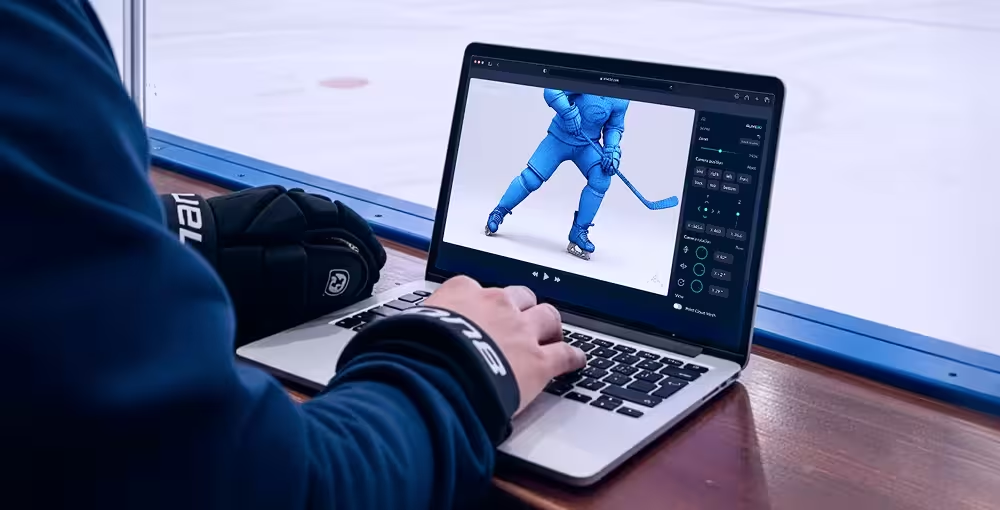
The outcome was a working proof of concept, and it confirmed the approach is technically feasible in fast-moving sport. We also turned the results into an interactive 3D web demo that presents them in a simple, accessible way. It’s available on ALIVE3D’s website for anyone to explore.
What breaks between a proof of concept and a real MVP
A proof of concept only has to work once, in front of the right people. An MVP has to keep working long after those people have left the room.
Three things tend to break in that gap:
- Repeatability. A calibration process that lives in one engineer's head doesn't survive turnover, and a result that "looks right" without a benchmark behind it isn't something you can trust.
- Headroom. Architecture built for today's sensor count becomes a rebuild, not an upgrade, the moment you need to add more. Better to design for growth before it's asked for.
- Paper trail. Documentation that only exists in someone's memory walks out the door with them.
All three of these showed up while building ALIVE3D's proof of concept, which is a big part of why it turned into a funded second phase of development instead of a demo that impressed a room and stalled.
Phase 1 delivered concrete results. The team reached microsecond-level synchronization across sensors and set up a real-time pipeline that handles heavy data throughput. The 3D demo built on top of it is now ALIVE3D’s main tool for investor presentations and partnerships.
A repeatable calibration method, data quality benchmarks, and full documentation gave the startup what it needed to secure Phase 2.

Choosing a sports software development partner who can actually build this
The team that gets a proof of concept working isn't always the right team to build the product around it. A few things tend to separate the two.
Have they solved hardware problems before, not just software ones? A team that's only ever shipped apps won't have the instinct, or the toolbox, for when a sensor mount fails on site. We've literally fixed one with a power drill.
It also matters what their discovery process de-risks. Real discovery means working through the technical unknowns, sensors, infrastructure, processing, before anyone commits to a full build, not after.
And there's the question of whether they'll still be around once the demo works. Teams that only show up for the flashy part have a habit of disappearing right when the harder, unglamorous build begins.
Is your POC ready to become an MVP?
Before committing budget, most sports analytics teams need honest answers to the same questions we had to answer for ALIVE3D:
- Do you have enough real-world data, not lab conditions, to validate fusion or tracking accuracy?
- Have your AI models been tested on live, fast-moving play, or only on clean recorded clips?
- If your primary hardware vendor fails you mid-project, can your team improvise a fix, or does everything stop?
- Is your infrastructure built for the sensor count you have today, or the one you'll need in Phase 2?
- Does anyone outside the original engineers understand the calibration and data-quality standards well enough to keep things moving without them?
- Is there a plan for what happens after the demo works, or does success end at the pitch deck?
Answer honestly, and you'll know whether you're building a proof of concept or a product.
Sources:
88% of AI pilots fail to reach production — but that’s not all on IT, CIO
FAQ
What's the difference between a proof of concept and an MVP in AI sports analytics?

A proof of concept proves something is technically possible, while an MVP proves real users can rely on it. That gap runs wider in AI sports analytics, where a demo only has to survive a pitch, not a season.
What does AI actually do in sports analytics?
It turns raw sensor data into something analysts can use. In a LiDAR and camera setup, AI combines both streams into one accurate 3D view of the game. That means more precise data on what actually happened, and room for new fan experiences.
Does a hardware-integrated MVP cost more than a typical software MVP?
Usually, yes. Sensors, calibration, and field-ready infrastructure add costs a pure software build never sees, and it's the most common thing founders underestimate.
How long does it take to go from proof of concept to MVP in sports tech?
Hardware readiness usually sets the pace. A software-only build can ship in weeks, but sensor calibration and field testing routinely add months before a prototype is ready to become an MVP.
Do I need a specialist partner, or will any software agency do?
It depends on how much the product leans on hardware. A generalist can build the app layer, but a sports startup software partner brings sensor integration and real-time processing experience a typical dev shop hasn't hit before.
What happens after the MVP stage?
Mostly scaling. Once an MVP lands funding or early customers, the work shifts to hardening the product for more venues, more sensors, and more concurrent users.