


Assess your fitness club

Qodeca

Product Design
Healthcare
Data Back Office

Qodeca created Tessera as a concept for hospitals and clinic networks that receive patient data from many systems. It merges GP, lab, EHR, and archive records from HL7 v2, FHIR, and scanned documents into one de-duplicated patient record that shows the source of every value.

4
component_thick
data sources in one record
5
component_thick
steps in the data pipeline
3
component_thick
options when two sources disagree

The challenges

At a multi-site provider, a patient’s history rarely lives in one place. EHRs, lab systems, and GP software each hold a piece, and gaps in healthcare interoperability keep those pieces apart.

The same patient, twice

Every source sends data in its own format, from HL7 v2 messages to FHIR APIs and scanned PDFs. Without a reliable master patient index, one person can end up with two records and one lab result can arrive twice.

Doses that don’t match

A GP prescription and a hospital discharge summary can list different doses for the same drug. Unless someone happens to compare them, medication reconciliation simply doesn’t happen.

Hours spent confirming details

When nobody can see where a value came from, clinicians verify it by phone or email. Data silos left by acquisitions and old archives pile even more manual checks on top.

Our approach

Two groups shaped every screen: health information management staff, who merge and correct incoming data, and clinicians, who need a patient record they can act on. Three principles guided the design.

Show the source

Every value carries its origin, author, and timestamp, so data provenance never requires a separate search.

Suggest, don’t decide

When sources disagree, Tessera proposes a resolution and explains why. Anything that affects care waits for a person to approve it.

Surface problems early

Broken feeds, duplicate patient records, and missing documents come to light before a visit, not in the middle of one.

case_study_process_overview

The solution

The design follows a record from the moment it arrives to the moment a clinician opens it.

Strategy & Market Alignment 

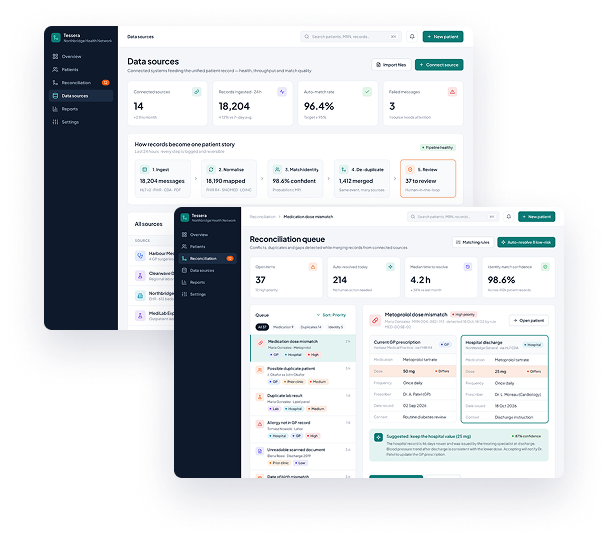
One screen tracks every HL7, FHIR, and scanned-document feed, including how much data arrived and what failed. Tessera matches each record to the right patient and removes duplicates. Anything uncertain goes to staff, and a broken connection shows which patients it affects.

Component-Driven Design

Medication mismatches, duplicates, and missing records land in one queue, sorted by priority. Staff see both versions side by side, with a suggested fix and the reasons for it. For a dose mismatch, one click accepts the suggestion, keeps the other value, or sends the case to a physician.

case_study_process_overview

A unified patient timeline

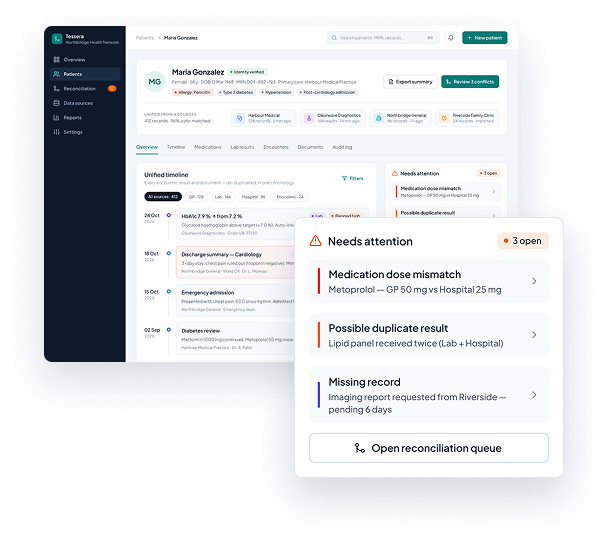
Encounters, lab results, and clinical documents from all connected sources form one de-duplicated timeline. HbA1c, blood pressure, and other key indicators sit beside it, together with reconciled medications. A short list of open issues keeps unresolved conflicts in plain sight.

case_study_process_overview

The main dashboard for records staff

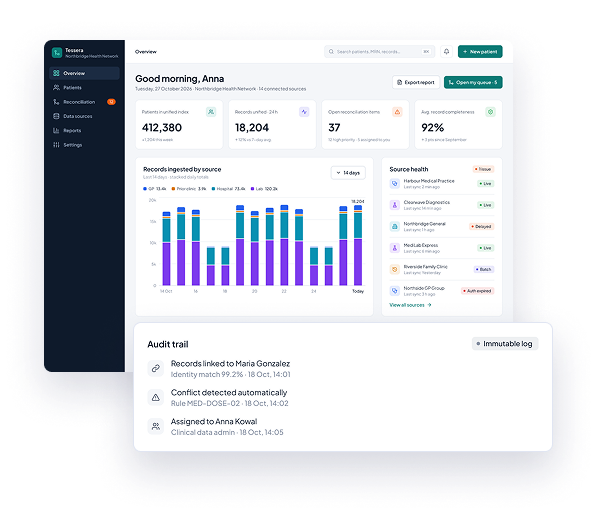
A morning dashboard shows records ingested per source, feeds that need attention, and each person’s work queue. Recent activity separates what was merged automatically from what still needs human review.

Full history behind every value

Color-coded badges mark whether a record came from a GP, lab, hospital, or previous clinic, and whether it has been matched. Dose changes trace back to who made them and when, giving compliance teams a full history of how the record was assembled.

The outcome

A complete design for patient data integration

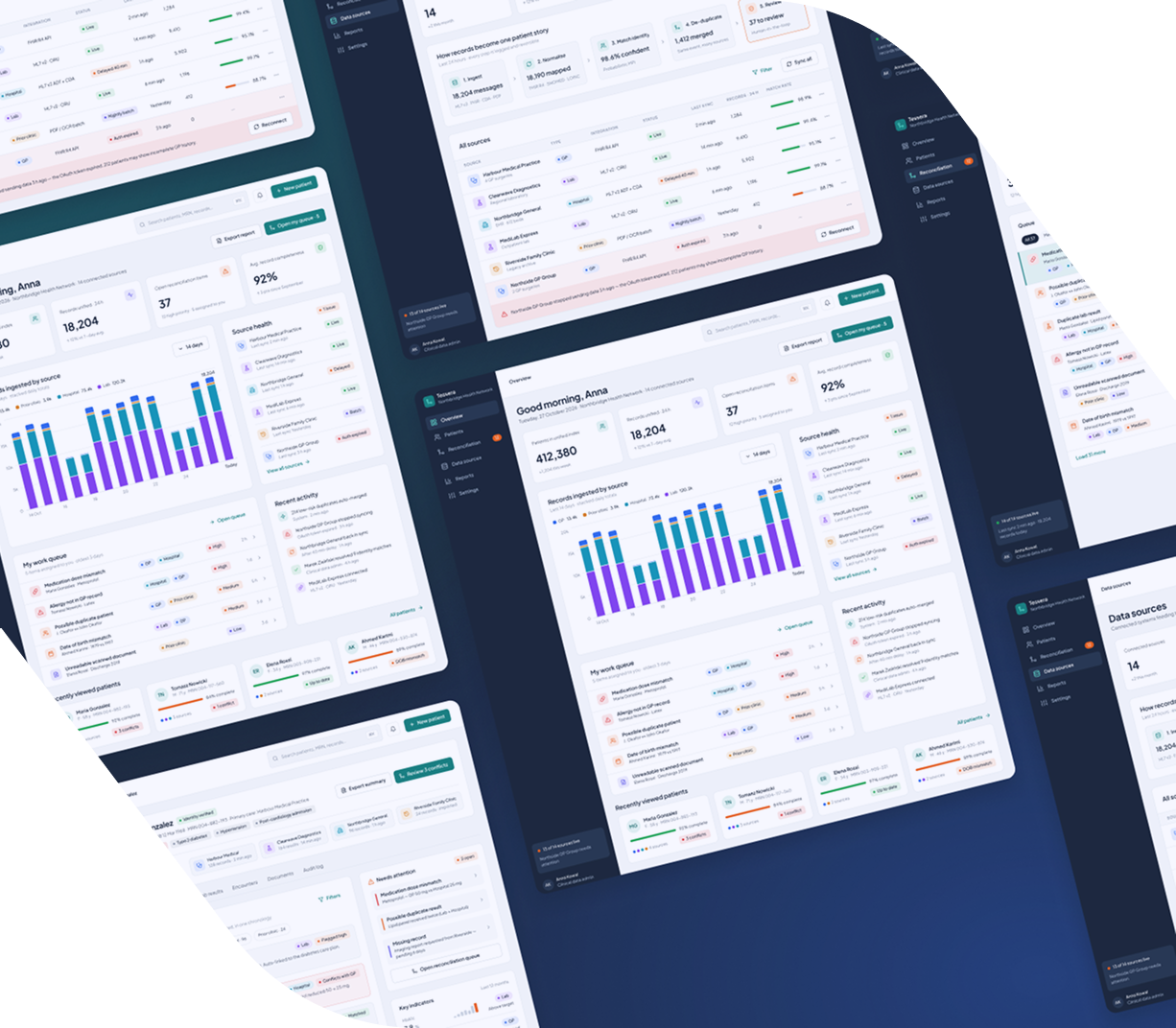
The concept covers four core screens and the whole pipeline, from an incoming HL7 or FHIR message to
a reviewed value in the patient’s record.

Automation with a person in the loop

Low-risk duplicates can be merged in bulk, while conflicts that affect care always wait for staff. With provenance visible on every value, clinicians no longer chase the original document, which matters wherever audits and regulatory reviews are routine.

What a pilot would measure

A pilot would focus on time to resolve a conflict, the auto-match rate, duplicate patient records caught, gaps found before a visit, and how often clinicians still go back to the original source.

case_study_info

More of Our
Success Stories

Explore how our partnership empowers brands in the fitness, sport, and healthcare industries to reach new levels of performance.

med_simpels_case_study

Custom Development

Business Operations

Healthcare

Medical staff management platform

Scaling healthcare safely: how we integrated secure scheduling and automated payments in a high-stakes hospital environment.

kaam_care_case_study

Mobile App

Product Development

Healthcare

User-friendly health management app

Putting patients first: building a real-time health platform where intuitive simplicity meets robust, enterprise-level data protection

qodeca_cta_experts
qodeca_cta_experts

Patient Data Spread Across Too Many Systems?

Tell us what you need to connect, and we’ll help you map the way to one record.